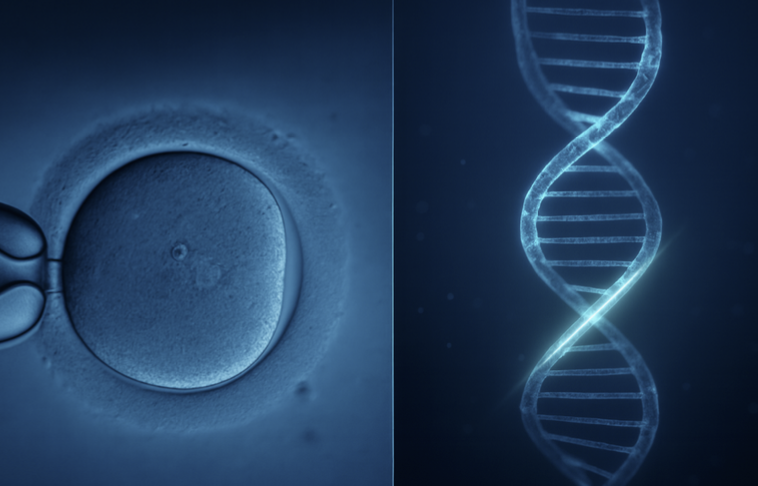
Somatic Cell Nuclear Transfer (SCNT), the method behind cloning, demonstrated that the replication of complex mammals is scientifically possible. Since the landmark cloning of Dolly the sheep in 1996, SCNT has remained a powerful—yet limited—tool in biotechnology. Today, a new frontier is emerging: CRISPR gene editing, which shifts the paradigm from copying life to engineering it with precision.
What is SCNT?
Somatic Cell Nuclear Transfer involves removing the nucleus from a donor egg cell and replacing it with the nucleus of a somatic cell from the organism to be cloned. This reconstructed egg is stimulated to develop into an embryo and implanted into a surrogate mother.
The concept is groundbreaking—an organism can be replicated almost identically. Yet, decades of practice have revealed deep constraints:
- Low efficiency: Only 1–10% of attempts result in viable offspring.
- High costs: Each procedure can cost tens of thousands of dollars.
- Ethical dilemmas: Donor animals often undergo invasive procedures, and surrogates face risks during gestation and birth.
SCNT’s legacy is profound, proving that cloning works, but its limitations have slowed widespread adoption in agriculture, medicine, and conservation.
The Rise of CRISPR: Engineering Beyond Replication
Unlike SCNT, CRISPR (Clustered Regularly Interspaced Short Palindromic Repeats) is not about copying but editing. By using a guide RNA and an enzyme like Cas9, CRISPR enables targeted cuts and modifications in DNA sequences. This shift unlocks transformative possibilities:
- Development of hypoallergenic pets.
- Healthier animals resistant to inherited diseases.
- Sustainable food sources through engineered organisms.
Where SCNT sought fidelity to the original, CRISPR embraces adaptability, opening pathways to redesign life for resilience, health, and sustainability.
From Cloning to Customization
The divergence between SCNT and CRISPR marks a pivotal shift in biotechnology. SCNT clones the past; CRISPR designs the future. In conservation, CRISPR can reintroduce genetic diversity into endangered species rather than merely replicating dwindling individuals. In agriculture, gene editing may secure global food systems against climate change. In medicine, it offers the potential to cure genetic disorders at their root.
This progression also raises new ethical questions. While SCNT sparked debates about identity and animal welfare, CRISPR introduces concerns about unintended mutations, ecological impacts, and the definition of what is “natural.”
A Converging Horizon
The two technologies are not mutually exclusive. In fact, combining SCNT with CRISPR may prove powerful: edited cells could be used in nuclear transfer to create animals that carry designed traits, effectively merging replication with engineering. This hybrid approach could accelerate breakthroughs in disease modeling, regenerative medicine, and biodiversity restoration.
The Future of Deeptech Biology
As deeptech advances, the conversation is moving beyond “Can we clone?” to “How can we responsibly engineer?” SCNT remains a cornerstone that showed replication was possible, but CRISPR is the tool reshaping what is possible.
From the creation of resilient crops to hypoallergenic pets and potentially even rewilded species, the shift from cloning to editing signals a future where biotechnology is not just about preserving life, but actively optimizing it for survival in a changing world.